
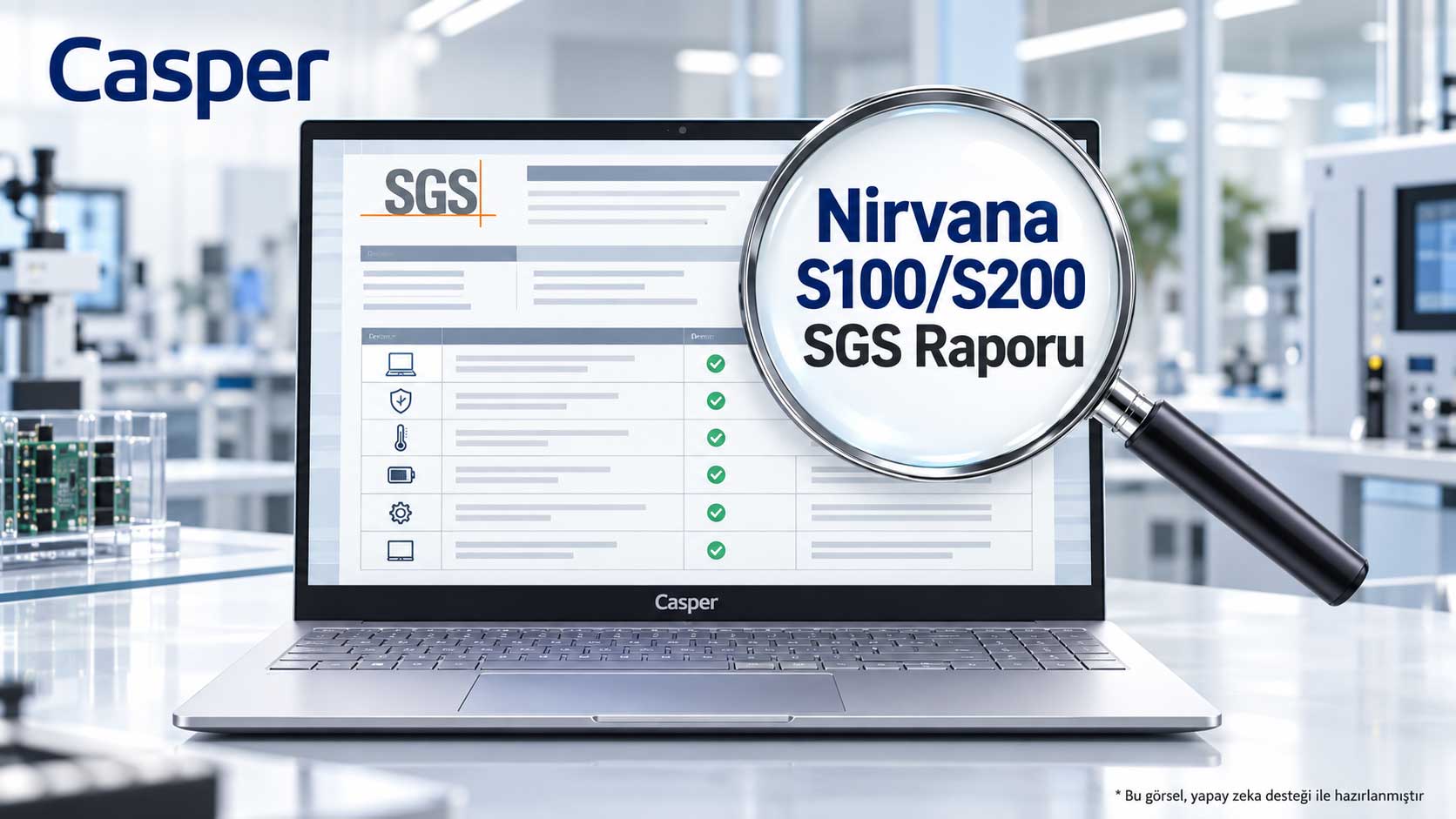
When purchasing business computers, another issue just as important as the processor, RAM and price is how technical specifications are verified through measurable tests. Especially in purchases involving hundreds of devices, a single catalogue value is not enough to explain real-world usage risks. The SGS report published for the Casper Nirvana S100/S200 255H examines productivity, thermal behaviour, battery life, display performance and hinge durability under separate test categories. This structure enables procurement teams to assess the device not only through a technical specification list, but also through measurements obtained under defined conditions.
The SGS Construction Check Report dated 20 August 2026 was published under report number TR_20261155_R1. The tested sample was a Casper Nirvana S100/S200 255H configuration equipped with an Intel Core Ultra 7 255H processor, integrated GPU and 64 GB DDR5 5600 MHz memory. The results apply only to this sample, the laboratory conditions stated in the report and the defined test methods; they should not automatically be generalised to other S100 or S200 configurations.
Premium aluminium chassis and 20,000-cycle hinge test
The Casper Nirvana S100 product page highlights its aluminium-alloy chassis and premium design lines. In the SGS mechanical durability test, the hinge of the tested S100/S200 sample was opened and closed a total of 20,000 times at a rate of one cycle per second. The product was inspected not only at the end of the test, but also at 5,000, 10,000, 15,000 and 20,000 cycles. At each checkpoint, the device was examined for cracks in the chassis, damage to the display cabling and any reduction of more than 20 percent in hinge friction resistance.
The absence of these three findings at all four checkpoints indicates that the hinge structure used with the premium aluminium chassis maintained mechanical consistency throughout the protocol in the tested sample. However, it would not be accurate to convert 20,000 cycles into a specific number of years of use. Daily opening and closing frequency, carrying habits, impacts, opening angle and environmental conditions differ from a laboratory cycle.
The PCMark Productivity result provides a measurable reference for business workloads
In the SGS report, the average of three measurements in the PCMark Productivity subtest is 18,544 points, while the acceptance criterion is 10,750 points. The report presents this result as 173 percent of the criterion. This measurement shows that the tested configuration clearly met the threshold defined in the relevant productivity protocol; it does not mean that the same performance is guaranteed across every ERP system, browser workload, video meeting or organisation-specific application.
From a corporate procurement perspective, this score is not a decision on its own, but a layer of comparable evidence. ERP clients, large spreadsheets, numerous browser tabs, VPNs, security software and video meetings can all change the real workload. Therefore, supplementing independent test data with an internal pilot is a more reliable way to validate RAM requirements, application compatibility and user experience under actual working conditions.
The four-hour thermal test shows behaviour under sustained load
In the four-hour load test, the highest reported chassis measurement was 42.25 °C at the centre of the bottom case; the criterion for this point was 48 °C. In the same report, the CPU sensor reached a maximum of 76 °C, while the GPU sensor reached 70 °C. Since the chassis surface and the processor or GPU sensors do not measure the same thing, these values should not be compared as though they represented a single temperature.
During the thermal test, the ambient temperature was maintained at 23 °C and the device was operated in Best Performance mode. These conditions make the measurement repeatable; however, ambient temperature, application load, power profile and airflow may vary in a real office. The 42.25 °C value should therefore be read as the result of the four-hour protocol described in the report, not as a statement that “the S100 operates at this temperature under all conditions.”
The battery result applies to a defined video playback and power-saving scenario
For the battery test, the device was set to Battery Saver mode, the internet connection was disabled and a 2K video was played. The average of three tests from 95 percent to 5 percent charge was recorded as 6 hours, 42 minutes and 2 seconds. The same report gives an average charging time of 2 hours, 2 minutes and 5 seconds from 5 percent to 100 percent. These values apply to the defined test scenario.
In business use, Wi-Fi, VPN, video meetings, high screen brightness, background synchronisation and different power profiles can alter consumption. Rather than turning the battery result into a definitive claim such as “guarantees a full working day,” it is more appropriate to pilot the intended configuration with the organisation’s typical workload.
Turning the SGS report into procurement specifications
The main value of an independent test report is that it converts catalogue information into measurable control areas. A procurement team can record hinge durability, thermal limits, productivity scores, the battery scenario, display checks and the full configuration code as separate items. This allows proposed devices to be compared not only by processor or price, but also by which test was conducted under which conditions.
Upgradeability and serviceability should also be assessed over the long-term device life cycle. The Nirvana S100 product page lists two SODIMM memory slots, support for up to 64 GB of memory and one M.2 NVMe storage slot. These are not findings of the SGS test; they are configuration details on the product’s current technical page. Keeping test evidence and product features distinct is important for evaluating technical data in the correct context.
Converting SGS data into procurement criteria
|
Test area |
Reported data |
Business interpretation |
|
Hinge |
20,000 cycles; four checks at 5,000-cycle intervals |
Verifies mechanical durability under the defined protocol |
|
Productivity |
PCMark Productivity: 18,544; criterion: 10,750 |
Shows that the tested configuration met the relevant criterion |
|
Thermal |
Highest chassis temperature: 42.25 °C; relevant criterion: 48 °C |
Result from the defined four-hour load conditions |
|
Battery |
95%–5% average: 6:42:02 |
Duration under Battery Saver mode, with internet disabled and 2K video playback |
|
Sample |
Core Ultra 7 255H / 64 GB DDR5 5600 |
Defines the configuration to which the results apply |
A second layer of validation in corporate assessment
Recording the report version and the tested sample is important in long-term procurement. The same product family may remain on sale over time with different processor, panel or memory options. Instead of listing only “S100” in the procurement record, keeping the full model code and configuration makes it clear which device the test data relates to. This record-keeping approach also reduces uncertainty in inventory, upgrade and service processes.
User feedback can also be quantified during the pilot stage. Common scenarios can be defined, such as the time required to open a large Excel file, fan behaviour during a video meeting, adequacy of screen brightness, battery consumption with the VPN enabled and the remaining battery percentage at the end of a working day. In this way, SGS laboratory data and the organisation’s own workload become two complementary data sets rather than alternatives.
Conclusion: test data is an evidence layer for the decision
Report TR_20261155_R1 measures performance, thermal behaviour, battery life, display performance and mechanical durability within the same framework for the tested Casper Nirvana S100/S200 255H sample. From a corporate procurement perspective, the key point is not a single high score, but the ability to read different forms of evidence—such as PCMark Productivity, the four-hour thermal measurement and the 20,000-cycle hinge test—together with their conditions. The final selection should also consider the exact configuration, an internal pilot, upgrade requirements, the service plan and total cost of ownership.
Frequently asked questions
How many years of use does 20,000 hinge cycles represent?
There is no direct equivalent in years. The SGS test represents 20,000 opening and closing cycles under a laboratory protocol, with interim inspections every 5,000 cycles. Because lid-opening frequency, one-handed opening, carrying, impacts and environmental conditions vary in real use, it would not be accurate to convert this result into a specific service life or warranty period.
Does the SGS test guarantee the same result for every Casper Nirvana S100 model?
No. The results in report TR_20261155_R1 apply to the tested sample equipped with an Intel Core Ultra 7 255H processor, integrated GPU and 64 GB DDR5 5600 MHz memory. Since other processor, memory or component options may be available within the same S100 or S200 family, the exact model code and configuration to be purchased should be checked separately.
What does a PCMark Productivity score of 18,544 mean?
The score of 18,544, which is the average of three measurements, is above the report’s acceptance criterion of 10,750 and corresponds to 173 percent of that criterion. It shows that the tested device met the threshold in the relevant productivity protocol. However, actual performance in the organisation’s ERP, VPN, security software or specialised applications should also be assessed through pilot use.
Is the 6-hour 42-minute battery result the expected duration in daily use?
This duration is the average of three tests from 95 percent to 5 percent charge under Battery Saver mode, with the internet connection disabled and 2K video playback. Wi-Fi, video meetings, high brightness, background applications and different power profiles can change consumption. The result is therefore a standardised comparison point, not a guarantee of real-world battery life.
How should the SGS report be used in corporate procurement?
The report can be used to add verifiable areas such as hinge durability, thermal behaviour, productivity and battery performance to the technical specification. The procurement team should record the report number, tested configuration and acceptance criteria, and then evaluate them together with an internal pilot, upgrade requirements, service coverage and total cost of ownership.